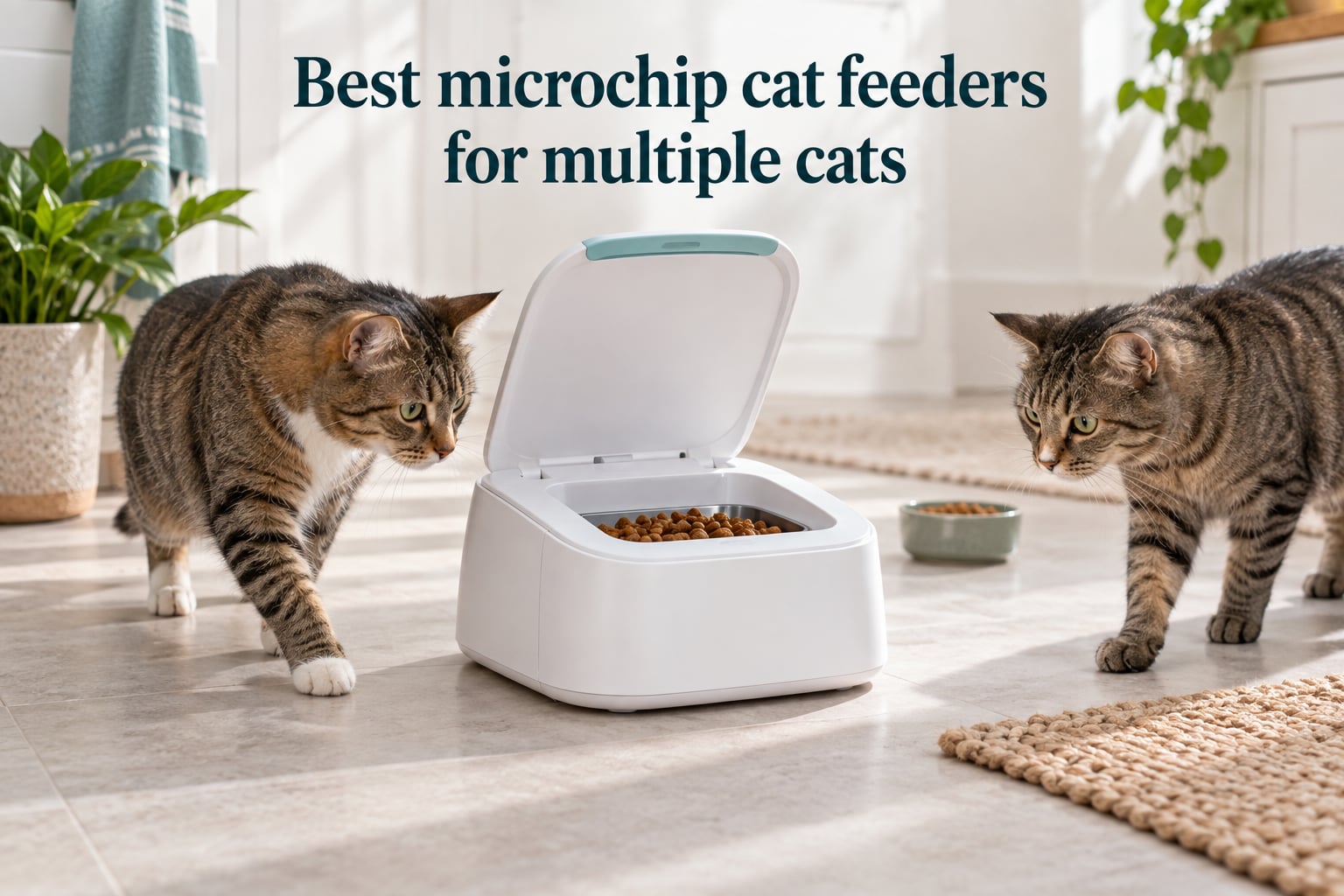
If you have two cats and one of them eats everything the other one is offered, a microchip cat feeder stops being a luxury purchase. It becomes the cheapest way to keep a prescription diet intact, hold an overweight cat to a measured portion, or shut a dog out of a bowl that was never meant for him. We spent weeks reading through owner feedback on selective feeders and testing the setup routines, and the picture that came back was clear: the tech works, but almost every complaint we found traces back to buying the wrong type of reader or rushing the introduction.
That second point matters more than it sounds. Most buyers do not realize that a microchip cat feeder and an RFID collar tag feeder are different products solving overlapping problems. A true microchip feeder reads the chip already implanted under your cat’s skin, so no collar is needed. An RFID feeder only responds to a tag on a collar, which is useless for a cat that refuses to wear one. Get that distinction right and the rest of the decision becomes simple.
In this guide to the best microchip cat feeders for multiple cats in 2026, we cover the seven selective feeders that carry enough owner feedback to judge properly, explain the compatibility rules by chip type, walk through the introduction protocol that keeps cats eating, and flag the failure modes real owners hit most. Every spec below comes from the manufacturer listing, and every verdict comes from the review record rather than the marketing copy.
One quick note for multi-cat homes that also have dogs: the same identification logic applies on the canine side, and we tested that category separately in our roundup of automatic dog feeders with microchip access.
Contents Table of Contents
- 1Top 3 Picks for Microchip Cat Feeders in 2026
- 2SureFeed Microchip Pet Feeder
- 3PETLIBRO RFID Automatic…
- 4HoneyGuaridan RFID Automati…
- 5Quick Overview: Best Microchip Cat Feeders for Multiple Cats in 2026
- 61. SureFeed Microchip Pet Feeder – Best Overall for Multi-Cat Homes
- 7Sure Petcare -SureFlap – SureFeed – Microchip Pet Feeder – Selective-Automatic Pet Feeder Makes Meal Times Stress-Free, Suitable for Both Wet and Dry Food – MPF001
- 8Spec sheet
- 9Pros
- 10Cons
- 11Who this feeder suits
- 12Who should look elsewhere
- 132. PETLIBRO RFID Automatic Cat Feeder – Best for App-Based Diet Tracking
- 14PETLIBRO RFID Automatic Cat Feeder, Collar Sensor for Personalized Meals, Cats Recognition, Diet Tracking and Anti-Stealing for Multi-Pets Homes and Different Diets, Wi-Fi Programmable Food Dispenser
- 15Spec sheet
- 16Pros
- 17Cons
- 18Check before you buy
- 19Where it falls short
- 203. HoneyGuaridan RFID Automatic Cat Feeder – 4.5 Rated With Flexible Power Options
- 21HoneyGuaridan RFID Automatic Cat Feeder,Collar Tag for Personalized Meal
- 22Spec sheet
- 23Pros
- 24Cons
- 25Where it earns its rating
- 26What to weigh first
- 274. ePawden Rechargeable Microchip Pet Feeder – Best for Simple No-App Setup
- 28ePawDen Microchip Pet Feeder – Rechargeable Selective-Automatic Cat Feeder with RFID & Microchip Recognition – Stainless Steel Bowl – Prevents Food Stealing in Multi-Cat Homes – for Wet and Dry Food
- 29Spec sheet
- 30Pros
- 31Cons
- 32Who should pick it
- 33What to weigh first
- 345. PawsPik Automatic Microchip RFID Cat Feeder – Best for Large Hoppers and Portion Scheduling
- 35PawsPik Automatic Microchip RFID Cat Feeder, 16-Cup, White
- 36Spec sheet
- 37Pros
- 38Cons
- 39Check before you buy
- 40What to weigh first
- 416. Vancpet RFID Collar Cat Feeder – Best for Wet Food on Ice Packs
- 42RFID Collar Cat Feeder for Multi-Cat Homes, Helps Reduce Stealing
- 43Spec sheet
- 44Pros
- 45Cons
- 46Where it makes sense
- 47What to weigh first
- 487. HEAPETS RFID Automatic Cat Feeder – Budget Pick With a Training Switch
- 49HEAPETS RFID Automatic Cat Feeder with Collar Sensor, Anti-Stealing Food Dispenser with Sealed Lid for Wet Dry Food and Different Diet for Multi-Pet Home, Auto Pet Feeder for Cats & Small Dogs, White
- 50Spec sheet
- 51Pros
- 52Cons
- 53Where it still makes sense
- 54What to weigh first
- 55Microchip vs RFID Collar Tag: Know What You Are Buying
- 56How Many Microchip Feeders Do You Actually Need?
- 57How to Introduce a Microchip Feeder Without Scaring Your Cat
- 58Microchip Cat Feeder Buying Guide: Nine Things to Check
- 59Frequently Asked Questions
- 60What are the best microchip feeders for multiple cats?
- 61Do microchip cat feeders work with any microchip?
- 62Can you use wet food in a microchip cat feeder?
- 63How long does it take a cat to get used to a microchip feeder?
- 64How many microchip feeders do I need for 3 cats?
- 65What happens if the microchip feeder batteries die?
- 66Final Verdict
Top 3 Picks for Microchip Cat Feeders in 2026
Three feeders came out ahead on the combination of compatibility, capacity and owner satisfaction. The SureFeed microchip feeder wins because it reads implanted chips, holds 32 identities and carries a three-year warranty. The PETLIBRO RFID feeder takes the app-driven slot with the largest review base we found in the category. The HoneyGuaridan unit rates 4.5 across its owner reviews and offers the most flexible power options of the three.
As an Amazon Associate we earn from qualifying purchases. CERTAIN CONTENT THAT APPEARS ON THIS SITE COMES FROM AMAZON. THIS CONTENT IS PROVIDED 'AS IS' AND IS SUBJECT TO CHANGE OR REMOVAL AT ANY TIME.
SureFeed Microchip Pet Feeder
- Reads implanted microchips
- RFID collar tag fallback
- Stores 32 pet IDs
- Wet or dry food
- 3 year warranty

PETLIBRO RFID Automatic…
- RFID collar tag access
- Stores up to 32 IDs
- 3L hopper
- App diet tracking
- Dual band WiFi
HoneyGuaridan RFID Automati…
- RFID collar tag access
- 19 cup sealed hopper
- Ceramic bowl
- Three power modes
- App control
Quick Overview: Best Microchip Cat Feeders for Multiple Cats in 2026
All seven feeders below restrict access to one identified cat. The differences that actually change your day: whether the unit reads an implanted microchip or only a collar tag, how many pet identities it stores, whether it works with wet food, and what happens when the power goes out.
| # | Product | Key details | Where to buy |
|---|---|---|---|
| 1 |
SureFeed Microchip Pet Feeder
|
|
Check Latest Price |
| 2 |
PETLIBRO RFID Automatic Cat Feeder
|
|
Check Latest Price |
| 3 |
HoneyGuaridan RFID Automatic Cat Feeder
|
|
Check Latest Price |
| 4 |
 ePawden Rechargeable Microchip Pet Feeder
|
|
Check Latest Price |
| 5 |
 PawsPik Microchip RFID Cat Feeder
|
|
Check Latest Price |
| 6 |
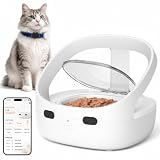 Vancpet RFID Collar Cat Feeder
|
|
Check Latest Price |
| 7 |
 HEAPETS RFID Automatic Cat Feeder
|
|
Check Latest Price |
As an Amazon Associate we earn from qualifying purchases, at no additional cost to you. CERTAIN CONTENT THAT APPEARS ON THIS SITE COMES FROM AMAZON. THIS CONTENT IS PROVIDED 'AS IS' AND IS SUBJECT TO CHANGE OR REMOVAL AT ANY TIME.
1. SureFeed Microchip Pet Feeder – Best Overall for Multi-Cat Homes
Sure Petcare -SureFlap – SureFeed – Microchip Pet Feeder – Selective-Automatic Pet Feeder Makes Meal Times Stress-Free, Suitable for Both Wet and Dry Food – MPF001
Spec sheet
- Reads implanted microchips
- Up to 32 stored IDs
- 13.5 fl oz wet or dry
- Three year warranty
Pros
- Reads implanted microchips so no collar is required
- Accepts 9
- 10 and 15 digit chip numbers
- Stores up to 32 pet identities
- Neoprene lip seal keeps wet food covered
- Three year warranty
- One button programming
Cons
- Lid motor is audible during operation
- Runs on four C batteries with no charging option
- Back cover is a separate purchase
As an Amazon Associate we earn from qualifying purchases, at no additional cost to you. CERTAIN CONTENT THAT APPEARS ON THIS SITE COMES FROM AMAZON. THIS CONTENT IS PROVIDED 'AS IS' AND IS SUBJECT TO CHANGE OR REMOVAL AT ANY TIME.
The SureFeed microchip pet feeder is the broadest compatibility story in this group: it reads the chip already implanted in your cat, and one of the review records we worked through belongs to owners describing it as working well for close to a year. That is the strongest longevity signal we found in the whole review set.
It accepts 9 digit Avid Secure, 10 digit FDXA and 15 digit FDXB numbers, with storage for up to 32 pet identities. One RFID collar tag is included as a fallback for a cat whose chip has not yet migrated to the shoulder or whose clinic has not scanned them yet. That combination means most households can start without a second appointment at the vet.
The bowl takes 13.5 fluid ounces of wet or dry food and the lid closes down onto a neoprene lip, so the food is covered rather than just hidden. In a household feeding wet food, that seal is the difference between a covered dish and a dry skin by afternoon. Setting it up is a single button press, which matters when the person doing it is tired and the cat is already demanding breakfast.
What you give up for all of that is silence. The lid motor is audible, and the unit runs on four C batteries with no rechargeable option or mains fallback, so a dead battery is a locked bowl until someone notices. There is no app and no feeding log, so if your cat stops eating you are relying on observation rather than data. The optional rear cover that blocks determined cats from reaching in from behind is not included.
Who this feeder suits
If your cats already have microchips, or you can arrange implantation, this is the one to buy. It is the right answer for a cat on a prescription diet in a three-cat household, because the 32 ID storage means one feeder covers the whole home rather than one restricted animal.
It also fits anyone who has a dog that raids the bowl, since the lid seals properly rather than merely closing. The warranty runs three years, and the manufacturer states the unit is veterinarian recommended.
Who should look elsewhere
Skip it if noise sensitivity is a real issue. Nervous cats startle at the motor, and while a gradual introduction solves that for most, it adds days to the process. It is also the wrong pick if you want portion logging or scheduled dispensing, because this feeder identifies rather than measures.
Anyone who wants wet-food monitoring through an app will find the sealed bowl underwhelming next to units with freshness sensors. And if you are working with a cat on a very tight calorie target, remember that this feeder controls access, not quantity.
As an Amazon Associate we earn from qualifying purchases, at no additional cost to you. CERTAIN CONTENT THAT APPEARS ON THIS SITE COMES FROM AMAZON. THIS CONTENT IS PROVIDED 'AS IS' AND IS SUBJECT TO CHANGE OR REMOVAL AT ANY TIME.
2. PETLIBRO RFID Automatic Cat Feeder – Best for App-Based Diet Tracking
PETLIBRO RFID Automatic Cat Feeder, Collar Sensor for Personalized Meals, Cats Recognition, Diet Tracking and Anti-Stealing for Multi-Pets Homes and Different Diets, Wi-Fi Programmable Food Dispenser
Spec sheet
- Collar tag RFID access
- Up to 32 stored IDs
- 3L hopper
- App diet tracking
Pros
- Largest feedback base in the category at 19341 reviews
- Real time diet tracking in the app
- RFID controlled lid and bowl shield
- 3L hopper sized at about two weeks for one cat
- Dual band 2.4 and 5GHz WiFi
- Backup battery power
Cons
- Reads supplied collar tags only and not implanted chips
- Your cat has to accept and keep wearing a tag
- Some cats need a training period before they will approach
As an Amazon Associate we earn from qualifying purchases, at no additional cost to you. CERTAIN CONTENT THAT APPEARS ON THIS SITE COMES FROM AMAZON. THIS CONTENT IS PROVIDED 'AS IS' AND IS SUBJECT TO CHANGE OR REMOVAL AT ANY TIME.
The PETLIBRO RFID automatic cat feeder is the app-first option, and its 19341 reviews make it the best-documented feeder in this roundup. If your problem is monitoring rather than enforcement, the diet tracking in the app is the feature that justifies the choice. Owners with two cats running two separate feeders report steady day-to-day use once the adjustment period passed.
Recognition is based on the collar sensor, and the housing shields both the lid and the bowl so a second cat cannot simply reach in from the side. Storage runs to 32 identities, which is generous for a household of two. The 3L hopper is sized at roughly two weeks of food for a single cat, so refills stop being a daily chore.
Connectivity runs on dual band WiFi, meaning 2.4GHz and 5GHz, which matters in a home where the 5GHz network is the only one reaching the kitchen. Backup battery power keeps the schedule running through an outage, and the feeding history in the app gives you a record you can take to a vet instead of relying on memory.
The limitation is fundamental: this reads the supplied collar tag, not an implanted microchip. If you are the kind of household where collars come off within a day or the cat flatly refuses one, this unit cannot enforce anything. The app connection is also a dependence, and owners have reported pairing friction when the network changes.
Check before you buy
Make sure your cat will wear a collar. That is the entire mechanism, and no amount of app polish compensates for a tag the animal sheds or rejects. Two-cat households running separate feeders get the most from the shared feeding log, since you can compare portions directly.
Also check your WiFi setup. Dual band support covers most modern routers, but a guest network on a separate band is a common reason pairing fails.
Where it falls short
It is an identification feeder, not a dispensing feeder, in this configuration. If you want timed meals with measured portions for a cat on a weight plan, the app shows the schedule but the hopper is the more relevant feature to weigh.
Expect a training period. The three physical controls are simple, but the cat has to learn that the lid opening means food, and rushing that step is where most early failures happen.
As an Amazon Associate we earn from qualifying purchases, at no additional cost to you. CERTAIN CONTENT THAT APPEARS ON THIS SITE COMES FROM AMAZON. THIS CONTENT IS PROVIDED 'AS IS' AND IS SUBJECT TO CHANGE OR REMOVAL AT ANY TIME.
3. HoneyGuaridan RFID Automatic Cat Feeder – 4.5 Rated With Flexible Power Options
HoneyGuaridan RFID Automatic Cat Feeder,Collar Tag for Personalized Meal
Spec sheet
- Collar tag RFID access
- 19 cup 4.6L sealed hopper
- Ceramic bowl
- Three power modes
Pros
- Rated 4.5 across its owner reviews
- Three power modes including a rechargeable lithium option
- Dual band 2.4 and 5GHz app control
- Five layer freshness sealing on a 4.6L hopper
- Adjustable lid opening speed
- Ceramic bowl included
Cons
- Reads collar tags only and not implanted microchips
- Only about two identities supported out of the box
- Short review history on a newer unit
As an Amazon Associate we earn from qualifying purchases, at no additional cost to you. CERTAIN CONTENT THAT APPEARS ON THIS SITE COMES FROM AMAZON. THIS CONTENT IS PROVIDED 'AS IS' AND IS SUBJECT TO CHANGE OR REMOVAL AT ANY TIME.
The HoneyGuaridan RFID automatic cat feeder rates 4.5 across its owner reviews, and the reasons behind that score are specific rather than generic. The adjustable lid opening speed is the standout. A slow-opening lid gives a nervous cat time to register the movement instead of flinching, which shortens the introduction period noticeably on skittish animals.
Power is the other differentiator. The unit runs from a 5V power cord, four AA batteries, or a lithium battery, so you can choose based on where it lives. Feeders stuck in a utility room on mains can move to a bedroom on batteries, and a household that dislikes disposable cells can use the rechargeable route instead.
Freshness protection is layered: a sealed lid, silicone gasket, desiccant, sealing rotor and bowl cover across a 19 cup, 4.6L hopper. That volume suits a household feeding one cat on a set portion, and the ceramic bowl is easier to keep free of lingering odours than plastic. Low food and low battery alerts land in the app alongside 2.4 and 5GHz control.
Two things to hold in mind. One collar tag is included and the unit supports up to two, which is tighter than the 32 identities the PETLIBRO and SureFeed models store. And like the PETLIBRO, it reads the tag rather than an implanted chip. The rating is high, but the review history is a fraction of the size, so there is less long-term data behind it.
Where it earns its rating
Choose this one for wet food in a home where the bowl sits out for hours. The five layer seal is the most thorough freshness story in the group, and the ice pack approach some owners use as a workaround elsewhere is effectively built in here.
It also suits anyone who wants app control without a fixed location. Three power modes mean the feeder can travel between rooms as the cat’s habits change.
What to weigh first
Check how many cats you actually need to authorise. Two IDs covers a small home, but a four-cat household with three different diets will outgrow it quickly and will need more than one feeder.
If your cats already have microchips and you would rather avoid collars entirely, this is the wrong family of feeder. The tag is the only route in.
As an Amazon Associate we earn from qualifying purchases, at no additional cost to you. CERTAIN CONTENT THAT APPEARS ON THIS SITE COMES FROM AMAZON. THIS CONTENT IS PROVIDED 'AS IS' AND IS SUBJECT TO CHANGE OR REMOVAL AT ANY TIME.
4. ePawden Rechargeable Microchip Pet Feeder – Best for Simple No-App Setup
ePawDen Microchip Pet Feeder – Rechargeable Selective-Automatic Cat Feeder with RFID & Microchip Recognition – Stainless Steel Bowl – Prevents Food Stealing in Multi-Cat Homes – for Wet and Dry Food
Spec sheet
- FDX-B chip and RFID tag support
- USB-C rechargeable,4 hour charge
- Up to 15 pets
- Stainless steel bowl
Pros
- Reads both FDX-B 15 digit chips and RFID tags
- Rechargeable over USB-C with up to six months per charge
- One button pairing with no app required
- Food grade 304 stainless steel bowl
- Dishwasher safe bowl
- Light at 2.43 pounds
Cons
- Small 500 ml bowl
- No app so no feeding history or scheduling
- Short review history on a newer brand
As an Amazon Associate we earn from qualifying purchases, at no additional cost to you. CERTAIN CONTENT THAT APPEARS ON THIS SITE COMES FROM AMAZON. THIS CONTENT IS PROVIDED 'AS IS' AND IS SUBJECT TO CHANGE OR REMOVAL AT ANY TIME.
The ePawden microchip pet feeder is the one to consider if you dislike apps and do not want a subscription-shaped dependency in your kitchen. Pairing is a single button, and there is no account, no network configuration and no firmware that can stop talking to your router. In a household where the person feeding the cats is not the person managing the smart home, that simplicity has real value.
It reads FDX-B 15 digit microchips and accepts RFID tags, so a cat without a compatible chip can still be authorised with the tag fallback. Up to 15 pets can be registered on one feeder, which covers most multi-cat homes and most homes with a dog in the mix.
The rechargeable battery is the practical headline. A four hour USB-C charge is listed to run the unit for up to six months, which removes disposable cells entirely and takes the dead battery lockout risk off the table. The food grade 304 stainless steel bowl holds up to 500 ml, is dishwasher safe and does not hold odour, and the sealed lid works with wet or dry food.
The trade-offs are capacity and visibility. At 500 ml the bowl is on the small side, so a cat on a larger wet portion may need two meals rather than one. With no app there is no feeding log, which matters more than it sounds if you are managing a prescription diet and need to show a vet what the cat actually ate. Review volume here is also very low, so long-term durability is largely unproven.
Who should pick it
Pick this if your cat already has an FDX-B 15 digit chip and you want zero ongoing battery cost. It is also the cleanest option for a household where everyone shares the same food and you mostly want theft prevention rather than diet enforcement.
The stainless bowl and light 2.43 pound body make it easy to move between rooms, which suits a cat that changes its eating spot seasonally.
What to weigh first
Check your cat’s portion size against 500 ml before you commit. If it does not fit with room to spare, you will be topping up mid-meal, and a cat that is interrupted mid-meal is a cat that goes looking elsewhere.
Also confirm your cat carries a 15 digit FDX-B chip rather than a different format. The manufacturer states FDX-B explicitly, and a mismatch here is the most common reason a cat never triggers the lid.
As an Amazon Associate we earn from qualifying purchases, at no additional cost to you. CERTAIN CONTENT THAT APPEARS ON THIS SITE COMES FROM AMAZON. THIS CONTENT IS PROVIDED 'AS IS' AND IS SUBJECT TO CHANGE OR REMOVAL AT ANY TIME.
5. PawsPik Automatic Microchip RFID Cat Feeder – Best for Large Hoppers and Portion Scheduling
PawsPik Automatic Microchip RFID Cat Feeder, 16-Cup, White
Spec sheet
- ISO 15 digit microchip support
- 16 cup hopper
- Up to 10 scheduled meals
- Closed or open mode
Pros
- Reads ISO compliant 15 digit implanted microchips
- Includes a PawsPik RFID tag for cats without a chip
- 16 cup capacity on a scheduled dispensing design
- App scheduling with up to 10 meals a day
- Backup battery for outages
Cons
- Only one pet ID per feeder
- A 3.9 rating with a small review sample
- Weighs 11 pounds and is bulky
As an Amazon Associate we earn from qualifying purchases, at no additional cost to you. CERTAIN CONTENT THAT APPEARS ON THIS SITE COMES FROM AMAZON. THIS CONTENT IS PROVIDED 'AS IS' AND IS SUBJECT TO CHANGE OR REMOVAL AT ANY TIME.
The PawsPik automatic microchip RFID cat feeder is the only unit here that combines implanted microchip reading with a large dry food hopper and app scheduling. The 16 cup capacity means a cat on scheduled dry meals can be covered for weeks between refills, and the app allows up to 10 meals a day with portion control. For a home feeding measured kibble rather than wet food, that pairing is distinct from everything else in the list.
Access control is genuinely dual mode. It reads ISO compliant 15 digit chips, and a PawsPik RFID tag is included for a cat whose chip does not match or who has not been scanned yet. The closed and open modes let you stage the transition, which is exactly the tool the introduction protocol below calls for.
Backup battery power covers outages, and the unit is listed as suitable for cats of all sizes and small dogs. That last point is relevant to multi-pet homes where a dog raiding the bowl is part of the problem rather than a hypothetical.
The design constraint is that each feeder pairs with only one RFID tag or microchip. In a three-cat household you would need three feeders, which multiplies cost quickly, and at 11 pounds it is the heaviest unit here, so placement matters. The 3.9 owner rating sits in the lower tier, and the review sample is small, so treat the feature list as promising and the long-term picture as unproven.
Check before you buy
Count your restricted diets, not your cats. If exactly one cat needs restricted food, a one-ID feeder with a 16 cup hopper is a clean fit. If two cats need different food, you are shopping for two feeders, and that changes the cost conversation entirely.
Confirm your cat’s chip is ISO compliant at 15 digits. The manufacturer is specific on this point, and older Avid chips will not read.
What to weigh first
Look at the size and weight before the features. At 11 pounds and 14.41 by 9.13 by 12.6 inches, it is not a shelf-edge device, and you need a stable spot where the cat will not be startled by the movement.
Also weigh the scheduling feature against your actual routine. Ten meals a day is generous, and pairing scheduled dispensing with a single ID means the schedule serves one cat only.
As an Amazon Associate we earn from qualifying purchases, at no additional cost to you. CERTAIN CONTENT THAT APPEARS ON THIS SITE COMES FROM AMAZON. THIS CONTENT IS PROVIDED 'AS IS' AND IS SUBJECT TO CHANGE OR REMOVAL AT ANY TIME.
6. Vancpet RFID Collar Cat Feeder – Best for Wet Food on Ice Packs
RFID Collar Cat Feeder for Multi-Cat Homes, Helps Reduce Stealing
Spec sheet
- RFID collar tag access
- Two ice packs included
- 1.7 cup removable bowl
- SmartLife Bluetooth app
Pros
- Two pre-freezable ice packs included for wet food
- Quiet lid with anti-pinch sensing
- Compact 4.05 pound body
- Removable bowl for easy cleaning
- SmartLife app with no subscription
- Available in 400ML and 2.13L variants
Cons
- Tag must be very close to the reader to trigger
- Bluetooth only so no remote monitoring
- Reports of inconsistent RFID recognition
- Only 44 reviews to judge reliability
As an Amazon Associate we earn from qualifying purchases, at no additional cost to you. CERTAIN CONTENT THAT APPEARS ON THIS SITE COMES FROM AMAZON. THIS CONTENT IS PROVIDED 'AS IS' AND IS SUBJECT TO CHANGE OR REMOVAL AT ANY TIME.
The Vancpet RFID collar cat feeder is built around a problem the larger sealed feeders solve less directly: a small portion of wet food that needs to stay cold for several hours. Two pre-freezable ice packs are included, so you can plate a single meal, freeze the packs over it, close the lid and walk out. In a household where each cat eats a quarter of a tin at a time, that is the difference between a workable plan and a dried-out dish by evening.
The lid is described as quiet with anti-pinch sensing, and the bowl is removable for cleaning. Both details matter more than they sound. A loud motor triggers the startle response, and a startle response during the first week is the most common reason a cat never returns to the feeder. The 400ML and 2.13L variants let you size the unit to the cat rather than the other way round.
Power is flexible: USB-C with a cord included, or C batteries. Note that the wall brick is not included, so you may need one of your own. The SmartLife app runs over Bluetooth, which means setup is quick and there is no subscription, but also that you get no remote monitoring while you are away.
The weakness is trigger sensitivity. Owners report the tag needs to come within roughly an inch of the reader, and infrared sensors can interfere with detection. There are also mixed reports on recognition reliability, and with only 44 reviews there is limited evidence either way. Microchip claims should be treated carefully: this is an RFID collar tag feeder, not an implanted chip reader.
Where it makes sense
Choose it for a single cat on a small wet portion where you need the food to hold temperature for a few hours. The ice packs remove a problem you would otherwise solve with a separate sealed bowl, and the compact body fits into tight spaces.
It also suits anyone who wants app setup without a WiFi network commitment, since Bluetooth pairing is short and uncomplicated.
What to weigh first
Test the tag range before you rely on it. If your cat has to press against the housing to trigger the lid, the enforcement is weak. A collar tag that works when the cat is motivated is not the same as one that works when a bolder cat is nearby.
And if your priority is implanted microchip reading, skip it. The route in is the tag, full stop.
As an Amazon Associate we earn from qualifying purchases, at no additional cost to you. CERTAIN CONTENT THAT APPEARS ON THIS SITE COMES FROM AMAZON. THIS CONTENT IS PROVIDED 'AS IS' AND IS SUBJECT TO CHANGE OR REMOVAL AT ANY TIME.
7. HEAPETS RFID Automatic Cat Feeder – Budget Pick With a Training Switch
HEAPETS RFID Automatic Cat Feeder with Collar Sensor, Anti-Stealing Food Dispenser with Sealed Lid for Wet Dry Food and Different Diet for Multi-Pet Home, Auto Pet Feeder for Cats & Small Dogs, White
Spec sheet
- Pre-paired RFID collar tags
- Airtight lid for wet or dry
- Retractable bowl
- Three button manual training mode
Pros
- Tags arrive pre-paired so setup takes minutes
- Airtight sealed lid covers wet and dry food
- Pinch free design with soft silicone edges
- Three button interface with a manual training switch
- Detachable food grade bowl
- Clear shield keeps the food area covered
Cons
- Reads collar tags only and never an implanted microchip
- Reportedly loud during operation
- Plug-in power with no battery backup
- Only one collar per feeder
As an Amazon Associate we earn from qualifying purchases, at no additional cost to you. CERTAIN CONTENT THAT APPEARS ON THIS SITE COMES FROM AMAZON. THIS CONTENT IS PROVIDED 'AS IS' AND IS SUBJECT TO CHANGE OR REMOVAL AT ANY TIME.
The HEAPETS RFID automatic cat feeder is the lowest-cost route into selective feeding on this list, and the tag arrives pre-paired, so there is no programming ritual on day one. That simplicity has real appeal for a first-time buyer. The three button interface includes a manual switch, which is a simple form of training mode: you hold the lid open on your terms, then reduce your help over several days.
The lid is described as airtight and works for wet and dry food. A clear protective shield and a retractable bowl keep the food covered and let you pull the bowl out for cleaning without dismantling the unit. The pinch-free design with soft silicone edges addresses the safety question parents ask about most, since a cat can and will put a paw in a closing lid.
The compromises are clear and worth weighing. The manufacturer states plainly that it does not support implanted microchip recognition, so every cat in the home needs a collar. Each feeder pairs with a single collar only. Operation is reported as loud by multiple owners, and the sensor can be inconsistent for taller cats, which is a real limitation in a household with a Maine Coon type.
There is also no battery option, which means a power cut locks the bowl. In our view that is the first thing to check in this category: a feeder that fails closed on a power outage can leave a cat without access to a prescription diet until someone is home. The lid also stays open for about ten seconds after the pet leaves, which lengthens the window for a bolder cat to investigate.
Where it still makes sense
Budget constraints are real, and this unit solves food stealing between two collar-wearing cats on the same diet. If everyone eats the same food and the goal is simply to stop the fast cat clearing the bowl before the slow one starts, the job gets done.
It is also a reasonable second feeder for a wet food cat, where the airtight lid does more work than the electronics do.
What to weigh first
Check two things before anything else. First, will your cat wear a collar at all, and will it tolerate the tag? Second, what happens in a power cut. With plug-in power only, the answer is a locked bowl, and in a household relying on the feeder for prescription food that risk needs a plan.
Also test the sensor with your tallest cat. Reports of inconsistent detection at height come up often in the reviews.
As an Amazon Associate we earn from qualifying purchases, at no additional cost to you. CERTAIN CONTENT THAT APPEARS ON THIS SITE COMES FROM AMAZON. THIS CONTENT IS PROVIDED 'AS IS' AND IS SUBJECT TO CHANGE OR REMOVAL AT ANY TIME.
Microchip vs RFID Collar Tag: Know What You Are Buying
A microchip cat feeder reads the transponder already implanted under your cat’s skin. An RFID feeder reads a tag on a collar. Both close a lid, both stop food stealing, and both are sold under the same search terms, which is why buyers so often end up with the wrong one.
Why the difference decides everything:
- Collar-averse cats. If your cat fights collars or sheds them within a day, a tag-only feeder is decorative. Only implanted microchip readers keep working.
- Do your cats already have chips? Most cats adopted from shelters and rescues arrive microchipped. Confirm at your next vet visit and ask them to read the number so you can check the digit format against the feeder’s list.
- Chip formats vary. The SureFeed is listed as working with 9 digit Avid Secure, 10 digit FDXA and 15 digit FDXB numbers. The PawsPik is listed for ISO compliant 15 digit chips only. The ePawden is listed for FDX-B at 15 digits. Anything outside those ranges will simply never trigger the lid.
- Frequency is not a setting. The common modern standard is 134.2kHz, and older 125kHz chips still turn up. A feeder does not let you switch frequencies, so an unmatched chip is a silent failure with no error message.
- Tag fallback is worth having. The SureFeed, PawsPik and ePawden feeders all accept an RFID tag alongside chip reading. That gives you a way in while a chip migrates from the neck to the shoulder, or before your cat has been scanned at all.
- Collar tags are an accessory cost. If a tag is lost, you are back to square one until a replacement is programmed, and tags are made for cats that rub, scratch and roll constantly.
The practical rule: if at least one cat will not reliably wear a collar, buy a feeder that reads implanted microchips. If all your cats are collar-averse, your options narrow to the three feeders on this list that read chips directly, and you should plan on one per restricted diet.
How Many Microchip Feeders Do You Actually Need?
Count the number of different diets in your home, not the number of cats. That single rule answers the question faster than any product feature list.
- One cat, one restricted diet. You need one feeder. Every other cat eats the same food from an open bowl, and the restricted cat gets a selective feeder. This is the most common setup in the owner accounts we read.
- Two cats, two different diets. You need two feeders. Owners running two PETLIBRO RFID feeders report this works, and it is the configuration where selective feeding genuinely earns its cost.
- Three cats, three diets. Three feeders. Owners with four cats typically run one feeder per cat, though several said that with only two cats they would have bought a single feeder.
- All cats on the same food, one steals from the slow eaters. One feeder is enough, used in open or semi-open mode. The goal here is slowing the fast cat down, not enforcing a diet.
- A dog in the mix. A sealed unit doubles as a dog-proof bowl. The same logic applies on the other side of the house, which is why we looked at microchip access feeders for dogs as well.
A common pattern in the forums is running one feeder per cat with the same food in each, purely so nobody is waiting. It works, but it multiplies the cost of the setup four times, and it is usually a decision made out of frustration rather than a considered one. If your cats share a diet, start with one feeder and add another only when you have a specific reason.
How to Introduce a Microchip Feeder Without Scaring Your Cat
The transition is where most selective feeder projects fail. Some cats take a couple of days just to tolerate the lid, and the general consensus among owners is that introduction takes one to three weeks. Rushing it is the biggest mistake, because a cat that associates the feeder with fear can develop lasting food avoidance.
That risk is not trivial. A cat that stops eating for more than a few days faces a real danger of hepatic lipidosis, a condition associated with fat accumulation in the liver during prolonged fasting. If your cat stops eating after the feeder appears, remove the feeder and go back a stage.
Stage one, days one to three: the food moves, the feeder stays away. Put your cat’s normal food in a different bowl in a quiet spot. Do not introduce the feeder yet. You are changing the location and the bowl so that the new setup does not arrive with a new object attached to it.
Stage two, days four to seven: the feeder appears switched off or in training mode. Set the feeder nearby, lid open, with your cat’s food in it. Eat your own meal nearby so the food smells familiar and the cat associates the spot with company rather than with a machine. The HEAPETS, PETLIBRO and PawsPik all have settings that support exactly this step.
Stage three, week two: the lid starts moving, food stays inside. Let the cat see the lid open and close while the food remains accessible. Reward any approach. If the cat leaves immediately, add another week to this stage rather than escalating.
Stage four, week three: program the chip and remove the hand-holding. Program the cat’s ID, then step away. Do not stand over the feeder, and do not return to check every few minutes. A cat that senses observation will eat quickly and then lose interest in the spot.
Two practical notes. Put the feeder somewhere a second cat cannot watch from above, because being observed while eating is its own deterrent. And check the tag or chip actually triggers the lid by walking your cat past it repeatedly before you leave home for the day, because a feeder that never opens looks identical to a feeder that is working.
Microchip Cat Feeder Buying Guide: Nine Things to Check
1. Implanted chip, collar tag, or both. This is the first filter. Cats that will not wear collars need a true microchip reader, and a tag-only feeder is a wasted purchase. If your cats are not yet chipped, book the implantation before you shop, or pick a feeder with a tag fallback.
2. Chip format and number of stored IDs. Check the stated digit formats against your cats’ actual chip numbers. The SureFeed lists 9, 10 and 15 digit support and stores up to 32 identities. The PawsPik is for ISO 15 digit chips and stores one. The ePawden is listed for FDX-B 15 digits and stores up to 15. A mismatch means the feeder never opens, with no error to tell you why.
3. Fail-open or fail-closed behaviour. Ask what happens when the power dies. The SureFeed runs on four C batteries, the ePawden on a rechargeable cell, the Vancpet on USB-C or C batteries, and the HEAPETS on plug-in power only. Battery-only feeders that fail closed are a risk in a household depending on the feeder for a prescription diet, so have a manual feeding plan for outages.
4. Wet food or dry food. Every unit here handles wet food, but the quality of the seal differs. The SureFeed closes onto a neoprene lip, the HoneyGuaridan uses a five layer seal across a 4.6L hopper, the Vancpet supplies two ice packs, and the HEAPETS is described as airtight. For a cat that grazes small wet portions, cooling matters as much as covering.
5. Bowl size and shape. Wide, shallow bowls that do not press on whiskers reduce whisker fatigue and make the cat more willing to return. Note the ePawden’s 500 ml bowl is a smaller one, and the Vancpet’s 1.7 cup bowl suits a partial tin rather than a full one.
6. Hopper capacity if you feed dry. The PawsPik runs at 16 cups, the HoneyGuaridan at 4.6L, and the PETLIBRO at 3L, which the manufacturer sizes at about two weeks for one cat. Capacity only matters if you are dispensing, so it matters less for pure access control.
7. Cleaning. Look for a removable or detachable food grade bowl that is dishwasher safe. The ePawden’s 304 stainless bowl and the HoneyGuaridan’s ceramic bowl both outlast plastic in a household that washes bowls daily, and a feeder that is awkward to clean is a feeder that gets cleaned badly.
8. Noise and training mode. Lid motor noise comes up again and again in owner reviews. A manual training switch, adjustable lid speed or training mode lets you control how fast the lid moves during the first fortnight, which is the difference between a nervous cat and a confident one.
9. Warranty and support. The SureFeed carries a three year warranty. The Vancpet lists 100 days of support. Longer ownership reports matter more than short ones, so favour a feeder with a warranty that outlasts the introduction period.
Two situations we see repeatedly in multi-cat homes. If a timid cat is being outcompeted at mealtimes, place its feeder in a separate room, and consider pairing that with more vertical space such as cat towers for multiple cats so the hierarchy is not settled at the bowl. If cats are competing for resting spots as well as food, cat window perches or cat condos take pressure off the same resource that the feeder is trying to protect.
Frequently Asked Questions
What are the best microchip feeders for multiple cats?
The SureFeed microchip pet feeder is the strongest all-round choice because it reads implanted microchips in 9, 10 and 15 digit formats, stores up to 32 pet identities, takes wet or dry food and carries a three year warranty. The PETLIBRO RFID feeder is the best app-driven option with the largest owner feedback base, and the HoneyGuaridan unit is the highest rated with the most flexible power options. For a household with four or more cats on different diets, budget for one feeder per restricted diet rather than one feeder for the home.
Do microchip cat feeders work with any microchip?
No. Compatibility depends on the chip format. The SureFeed is listed as working with 9 digit Avid Secure, 10 digit FDXA and 15 digit FDXB numbers. The PawsPik is listed for ISO compliant 15 digit chips only, and the ePawden for FDX-B 15 digit chips. A mismatched chip means the lid never opens, and there is no error message to explain why. Most modern chips run at 134.2kHz, but older 125kHz chips still exist and feeders do not let you switch frequencies, so check your cats’ numbers before buying.
Can you use wet food in a microchip cat feeder?
Yes, but the seal and the cooling matter. The SureFeed holds 13.5 fluid ounces of wet or dry food and closes onto a neoprene lip. The HoneyGuaridan uses a five layer seal across a 4.6L hopper, the Vancpet includes two pre-freezable ice packs for small wet portions, and the HEAPETS lid is described as airtight. Wet food left out for hours also attracts flies, which is the reason a genuine seal rather than a simple cover is worth paying for.
How long does it take a cat to get used to a microchip feeder?
One to three weeks for most cats, and longer if you rush it. Owners describe cats taking a couple of days just to tolerate the lid, and the consensus is that the transition cannot be compressed. Use a four stage process: move the food to a new bowl for three days, introduce the feeder with the lid held open, let the cat see the lid move with food still inside, and only then program the chip and step away. A cat that stops eating is at risk of hepatic lipidosis, so remove the feeder and return a stage rather than pushing through.
How many microchip feeders do I need for 3 cats?
Count the number of different diets, not the number of cats. Three cats sharing one food need one feeder to slow the fastest eater down. Two cats on two different diets need two feeders. Three cats on three different diets need three, and the SureFeed’s 32 stored identities means one feeder can hold all three authorised cats if you are using access control rather than portion control. Check the ID capacity on narrower options, because the PawsPik stores only one pet per feeder.
What happens if the microchip feeder batteries die?
It depends entirely on the design, and this is worth checking before you buy. The SureFeed runs on four C batteries with no charging option, the ePawden is rechargeable over USB-C for up to six months per charge, the Vancpet runs on USB-C or C batteries, and the HEAPETS is plug-in only with no battery fallback. A unit that fails closed on a power cut leaves a cat locked out of a prescription diet, so if you rely on the feeder for medically restricted food, keep a manual feeding plan for outages.
Final Verdict
For most multi-cat households, the SureFeed microchip pet feeder is the right first purchase. It reads implanted chips across the widest range of formats, stores enough identities for a large home, seals properly for wet food, and carries a three year warranty. The compromises, namely a visible motor and disposable batteries, are real but manageable once the introduction is done properly.
Choose the PETLIBRO RFID feeder instead when your cats will wear collars and you want feeding history in an app rather than a sealed bowl. Choose the HoneyGuaridan for a 4.5 owner rating, layered wet food storage and three power modes. For simplicity with no app at all, the ePawden covers implanted FDX-B chips and RFID tags on a rechargeable cell. The PawsPik is the pick for a large dry food hopper with scheduled portions, the Vancpet for small wet meals on ice packs, and the HEAPETS when cost is the deciding factor and your cats are happy in collars.
Whichever feeder you choose, check your cats’ chip numbers before you order, and give the introduction the three weeks it deserves. That is the part of the process most people rush, and it is the part that decides whether the feeder ends up used daily or abandoned in a corner. These are the best microchip cat feeders for multiple cats in 2026, and the best of them is the one your cat actually eats from every day.